Serving Colorado since 1915, the Business Research Division (BRD) conducts economic and fiscal analysis, market research, and customized research projects. The division also annually produces a sector by sector economic forecast of the state’s economy. This work helps companies, associations, nonprofits, and governmental agencies make sound business and policy decisions.
Business leaders and policy makers rely on research conducted by the division for relevant information and data. The annual Colorado Business Economic Outlook provides a sector-by-sector forecast for the state’s economy, while the quarterly Leeds Business Confidence Index gauges Colorado’s business Leaders’ opinions about the national and state economies and how their industry will perform in the coming quarter. A quarterly electronic newsletter, the Colorado Business Review, also provides decision makers with in-depth analysis and information about Colorado’s economy.
Over the 2010-11 academic year the BRD conducted economic impact, revenue forecasting, and fiscal studies for private-sector companies and nonprofit organizations related to proposed materials recovery facilities, the implementation of Colorado’s Clean Air-Clean Jobs Act, community events, and transportation. It also completed studies for the public sector related to Colorado’s economy, community industry assessment, and international trade. The BRD continues to perform outreach to Colorado businesses, governments, and nonprofits through customized research projects and presentations, Colorado Business Review issues, the Leeds Business Confidence Index, and the annual Colorado Business Economic Outlook.
In the next year, the BRD will once again be in the forefront of Colorado’s economic forecasting as it compiles and presents the 47th annual Colorado Business Economic Outlook on December 5, 2011, at the Grand Hyatt in Denver. The BRD is committed to providing the business and economic information that Colorado businesses and governments need and informing the public on important economic conditions and policy impacts.
The University of Colorado is the nexus of research and teaching that reaches far beyond economic statistics that quantify purchases and payroll in the state of Colorado. That said, the university’s economic impacts still resonate as an economic engine driven by education and research expenditures. This enterprise, which directly employs 27,500 faculty, staff, and student workers, shares the complexity of any large corporation. Funding from tuition, grants, contracts, gifts, and appropriations is turned around and spent in private industry. These purchases, which range from food services to energy to equipment, leave an economic imprint of $5.3 billion on the state of Colorado and directly and indirectly employ 43,500 in the state. The $246 million in construction in fiscal year (FY) 2011 alone had economic benefits of $478 million, concentrated in an industry disproportionately affected by the recession.
This public university serves “Colorado, the nation and the world through leadership in high-quality education and professional training, public service, advancing research and knowledge, and state-of-the- art health care.” With education as a core element of this mission, the University of Colorado enrolled 57,400 students in the fall of 2010 and awarded 14,525 degrees for the year. An estimated 192,000 alumni reside in the state, contributing to Colorado’s economic and social fabric. Evidence of the university’s educational impact can be found in the leadership of private businesses, teachers in classrooms, health-care professionals, and policy makers. These alumni are an integral part of the Colorado labor force, particularly in the high-tech workforce, and contribute to the state’s rank as second in the nation for educational attainment.
Leveraging the $181.6 million in state funding FY2011, the university operated on $2.7 billion in noncapital revenues. A significant portion of this leveraged funding was related to sponsored program and other restricted fund activity, primarily associated with research activity. Sponsored program awards in FY2011 exceeded $793 million, were concentrated on the Anschutz Medical Campus and the Boulder campus, and were predominately comprised of funding from the National Institutes of Health, the National Science Foundation, NASA, the Department of Defense, and the Department of Commerce. In fact, 68% of FY2011 awards and 78% of research expenditures were federal in nature. This funding flows to departments and researchers with unique expertise, concentrated in fields such as biotechnology and aerospace, which lends to activity in specific industries and clusters in the state. This activity supports the concentration of companies, where Metro Denver alone touts cluster employment concentrations that far exceed the nation, including aerospace (5.1 times the national average), telecommunications (2.9 times), cleantech (2 times), medical devices and diagnostics (1.7 times), and financial investments (1.6 times). Some federal research laboratories (e.g., joint institutes) are located in Colorado because of the university. They are often on university grounds and partially staffed by university employees, leading to a high relative concentration of federal research laboratories in the state.
The University of Colorado’s Technology Transfer Office is the conduit for technology commercialization. From CU intellectual property, 114 companies have been formed, 85 of which continue to operate in Colorado, and 11 of which were formed in FY2011 alone. These companies are taking risks to create innovative technological impacts, such as OPX Biotechnologies, a cleantech company creating proven alternatives to petroleum products, and Arca biopharma, a firm customizing treatment to improve cardiovascular health.
The University of Colorado collaborates in a research triangle that includes universities, businesses, and federal laboratories. These concerted efforts, with support from state and federal funds, help ensure Colorado’s economic vitality. From direct expenditures and spinoff technologies to collaborative research and an educated workforce, the University of Colorado strengthens Colorado’s economy.
Colorado Business Economic Outlook
This forecast analyzes changes that have taken place in all economic sectors during the past year, and looks at the events and activities that will shape the changes in our population, employment, and overall economy for the coming year.
Current Forecast
2012 Colorado Business Economic Outlook Forum
Monday, December 5, 2011
1:00pm-6:00pm
Two-and-a-half years have passed since the National Bureau of Economic Research officially declared the end of the recession, and the nation is still experiencing slow economic growth. Employment is showing gains, jobless claims are generally declining, incomes are rising modestly, and GDP numbers point to sustained economic growth.
For many in the United States, however, it still feels like the country is rooted in recession, and the economic conditions that lead us into 2012 are anything but certain. The eurozone crisis, if left unabated, will undoubtedly wreak havoc in U.S. markets. The nation continues to add jobs month-over-month, but the pace of job growth is falling far short of a V-shaped recovery. Measures of wealth, including home values and investments, have yet to provide stable footing. Of looming concern is the lack of consensus of the 12-member Joint Select Committee on Deficit Reduction (the “super committee”), which was charged with finding $1.5 trillion in debt savings over 10 years. Hiring has been slow, with employers investing in capital before reinvesting in labor.
However, efforts are being made by the private and public sectors to sustain the recovery. Companies are doing what they know best—finding ways to market goods and services even during the most uncertain of times. Consumer-driven firms are suc- cessfully taking measures to lure customers back to the market through attractive pricing and payment programs, including the return of layaway. Despite the current debt debate in Washington, lawmakers continue to devise plans to spur growth with ideas ranging from incentives to tax cuts. The Fed also continues to reinvent—following two quantitative measures to lower long-term interest rates through an exercise dubbed “Operation Twist.”
Looking to 2012, the rate of expansion will be most influenced by employment growth, the European sovereign debt crisis, and federal spending cuts.
Leeds Business Confidence Index
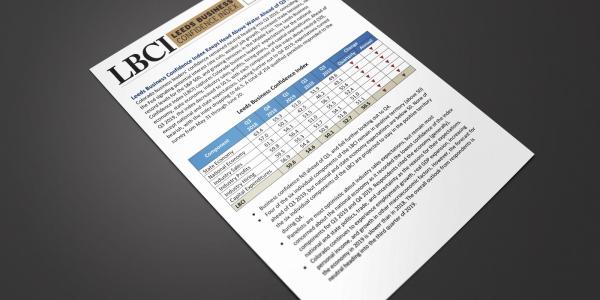
The Leeds Business Confidence Index (LBCI) is a forward-looking index that gauges business leaders’ opinions about national and state economic trends and how their industry will perform in the coming quarter.
Each quarter, Colorado business leaders are invited to complete a brief online survey about next-quarter expectations. The survey results are then compiled into the LBCI.
Looking ahead to Q2 2012, Colorado business leaders’ optimism continues to improve. The Leeds Business Confidence Index (LBCI) measures the confidence of Colorado business leaders in six categories: national economy, state economy, industry sales, industry profits, hiring plans, and capital expenditures. The LBCI’s reading improved from 54.5 in Q1 to 62.2 in Q2.
Confidence improved for all metrics, rising farther above the neutral mark (50). Expectations for the state and national economies both moved higher, with state expectations rocketing from 58.4 to 67.1. The expectations differential between the state and the nation continued in Q2 at 4.9, indicating greater confidence in the local economy than the national. The vast majority of survey respondents expect that Colorado wage increases will be in the 0 to 4% range in 2012. This is consistent with national estimates of 2% wage gains. Modest year-end bonuses are anticipated to augment households’ income as well, although benefits will likely remain unchanged.
The Q2 outlook builds on optimism present in the Q1 survey. While uneasiness concerning the European debt crisis may have led to cautious optimism last quarter, greater stability in Europe and encouraging reports on consumption and job growth seem to have boosted confidence for Q2 2012. In the past three months the fear of a second recession has abated significantly and the prospect of the U.S. economic recovery gaining real traction has increased.
Looking ahead to Q2 2012, month-over-month employment figures and jobless claims are pointing to an improving labor market. However some drags on the recovery still persist—the European debt crisis, weak housing prices and relatively low levels of construction activity.
Business Research Division researchers have expertise in conducting marketing and economic impact studies using web-based, mail, and telephone surveys; focus groups; personal interviews; and data mining/analysis. Recent clients include those in the following industries:
Travel, tourism, and recreation
Workforce
Economic development
Government and policy
Film
Recycling
Technology (photonics and nanotechnology)
The BRD presents an annual Colorado Business Economic Outlook Forum each December in Denver, followed by targeted presentations of the forecast to organizations across the state and nation. Forecast includes snapshots from specific counties and regions around the state, as well as updates on international trade, population, labor force and personal income growth, and a general outlook on the national economy.
Through its annual Colorado Business Economic Outlook, the BRD has established a base of knowledge that adds value to the division’s work in other areas. The BRD conducts research in a variety of areas, including travel, tourism, and recreation; workforce; government and policy; and economic development for businesses, governments, and nonprofits. Through data analysis, surveys (direct mail, web-based, and telephone), focus groups, and personal interviews, the BRD assists clients with making better-informed business and policy decisions.
Local, Regional, and State Research
The Business of Sports
The Leeds School of Business is launching a new two-month Business of Sports Intensive Certificate Program starting in June. Intended for students and recent graduates who are interested in pursuing careers in the sports and recreation industry, the curriculum includes studies in basic business topics integrated with industry-specific sports projects. Projects will be designed by one of the program's contributing partners, including the Denver Nuggets, the Denver Broncos, Alem International Management, and Vail Resorts. The BRD will offer students expertise and knowledge on various aspects of the research process.
Boulder Economic Drivers
Identified industries and clusters that drive the City of Boulder and Boulder County economies in 2008. The most significant and primary industries support the advanced technology and tourism clusters.
The Leeds Business Confidence Index (LBCI) is a forward-looking index that gauges business leaders’ opinions about national and state economic trends and how their industry will perform in the coming quarter.
Each quarter, Colorado business leaders are invited to complete a brief online survey about next-quarter expectations. The survey results are then compiled into the LBCI.
Colorado’s Economic Opportunities: Today, Tomorrow, and the Future
Part One analyzed 13 industries identified as having growth potential in Colorado. Part Two evaluated the economies of the state's 64 counties.
Colorado Photonics Industry Directory and Analysis
This update includes an analysis of the photonics industry and a listing of all companies related to the industry in the state.
A Survey of Colorado Recreation Trends, Issues, and Needs
Examined the recreational activities, demands, facility and service preferences, expectations, and motivations of recreation participants. Also assessed the receptivity of the public to various funding strategies for local, state, and federal lands.
Colorado Nanotechnology Roadmap
Developed a customized three-year action plan and created a database of Colorado firms involved with nanotechnology. (2006)
Developed a database of organizations conducting homeland security research and organizations providing services or selling homeland security products in Colorado. Also identified a preliminary set of issues related to conducting homeland security research and business in the state. (2005)
CO-LABS Economic Impact Study: The Impact of Federally Funded Research Laboratories in Colorado
Quantified the economic impacts that federal research facilities and their university affiliates have on Boulder, Jefferson, and Larimer counties; the Denver Metro region; and the state of Colorado.
The Impact of Federal Government Facilities in the Denver Metro Region on the Region and on the State of Colorado
Determined the economic and fiscal contributions of federal facilities on the state of Colorado; and Adams, Arapahoe, Boulder, Broomfield, Denver, Douglas, and Jefferson counties (the Metro Denver region). Analyzed the economic impact, including economic benefits, public revenues, and public costs, of Metro Denver federal facilities from 2005-2008.
A baseline analysis of the film industry conducted to determine economic impacts, examine the industry’s structure, and understand the intangible benefits. (2003)
The Economic Impact of the Arts on Aspen and Snowmass
This study determined the economic impact of the organizations and audiences of the Aspen/Snowmass Council for the Arts on the Pitkin County area. (2004)
Colorado's economy is forecasted to improve, according to Richard Wobbekind, senior associate dean of academic programs at the Leeds School of Business. One-third of Colorado companies surveyed plan on hiring more employees this quarter and Wobbekind expects the GDP to increase 2.5 percent.
Leeds' Business Research Division found that Colorado's craft brewing business creates an output of $446 million annually. Five of the largest 50 craft breweries are based in Colorado, creating a budding beer tourism market.
Colorado business confidence improves 7.2 points and companies plan more hiring and investment, according to the Leeds Business Confidence Index for the first quarter of 2012.
The federal laboratories in Colorado together with their affiliates contributed $1.5 billion to the state economy in fiscal year 2010, and accounted for more than 16,000 direct and indirect jobs, a new survey shows.
An analysis by the University of Colorado shows that the U.S. Department of Energy’s National Renewable Energy Laboratory (NREL) in Colorado is a $714 million annual boost to the state's economy.
Published quarterly by the Business Research Division, the Colorado Business Review newsletter provides in-depth analysis and information about Colorado’s economy.
The Leeds Business Confidence Index (LBCI) is a forward-looking index that gauges business leaders’ opinions about national and state economic trends and how their industry will perform in the coming quarter.
Published quarterly by the Business Research Division, the Colorado Business Review newsletter provides in-depth analysis and information about Colorado’s economy.
The Leeds Business Confidence Index (LBCI) is a forward-looking index that gauges business leaders’ opinions about national and state economic trends and how their industry will perform in the coming quarter.
Published quarterly by the Business Research Division, the Colorado Business Review newsletter provides in-depth analysis and information about Colorado’s economy.
The Leeds Business Confidence Index (LBCI) is a forward-looking index that gauges business leaders’ opinions about national and state economic trends and how their industry will perform in the coming quarter.
Each quarter, Colorado business leaders are invited to complete a brief online survey about next-quarter expectations. The survey results are then compiled into the LBCI.
Published quarterly by the Business Research Division, the Colorado Business Review newsletter provides in-depth analysis and information about Colorado’s economy.
The Leeds Business Confidence Index (LBCI) is a forward-looking index that gauges business leaders’ opinions about national and state economic trends and how their industry will perform in the coming quarter.
Each quarter, Colorado business leaders are invited to complete a brief online survey about next-quarter expectations. The survey results are then compiled into the LBCI.
Published quarterly by the Business Research Division, the Colorado Business Review newsletter provides in-depth analysis and information about Colorado’s economy.
The Leeds Business Confidence Index (LBCI) is a forward-looking index that gauges business leaders’ opinions about national and state economic trends and how their industry will perform in the coming quarter.
Each quarter, Colorado business leaders are invited to complete a brief online survey about next-quarter expectations. The survey results are then compiled into the LBCI.
Published quarterly by the Business Research Division, the Colorado Business Review newsletter provides in-depth analysis and information about Colorado’s economy.
The Leeds Business Confidence Index (LBCI) is a forward-looking index that gauges business leaders’ opinions about national and state economic trends and how their industry will perform in the coming quarter.
Published quarterly by the Business Research Division, the Colorado Business Review newsletter provides in-depth analysis and information about Colorado’s economy.
This forecast analyzes changes that have taken place in all economic sectors during the past year, and looks at the events and activities that will shape the changes in our population, employment, and overall economy for the coming year.
The Leeds Business Confidence Index (LBCI) is a forward-looking index that gauges business leaders’ opinions about national and state economic trends and how their industry will perform in the coming quarter.
Published quarterly by the Business Research Division, the Colorado Business Review newsletter provides in-depth analysis and information about Colorado’s economy.
The Leeds Business Confidence Index (LBCI) is a forward-looking index that gauges business leaders’ opinions about national and state economic trends and how their industry will perform in the coming quarter.
Published quarterly by the Business Research Division, the Colorado Business Review newsletter provides in-depth analysis and information about Colorado’s economy.
The Leeds Business Confidence Index (LBCI) is a forward-looking index that gauges business leaders’ opinions about national and state economic trends and how their industry will perform in the coming quarter.
Published quarterly by the Business Research Division, the Colorado Business Review newsletter provides in-depth analysis and information about Colorado’s economy.
The Leeds Business Confidence Index (LBCI) is a forward-looking index that gauges business leaders’ opinions about national and state economic trends and how their industry will perform in the coming quarter.
Published quarterly by the Business Research Division, the Colorado Business Review newsletter provides in-depth analysis and information about Colorado’s economy.
The Leeds Business Confidence Index (LBCI) is a forward-looking index that gauges business leaders’ opinions about national and state economic trends and how their industry will perform in the coming quarter.
Published quarterly by the Business Research Division, the Colorado Business Review newsletter provides in-depth analysis and information about Colorado’s economy.
The Leeds Business Confidence Index (LBCI) is a forward-looking index that gauges business leaders’ opinions about national and state economic trends and how their industry will perform in the coming quarter.
Published quarterly by the Business Research Division, the Colorado Business Review newsletter provides in-depth analysis and information about Colorado’s economy.
The Leeds Business Confidence Index (LBCI) is a forward-looking index that gauges business leaders’ opinions about national and state economic trends and how their industry will perform in the coming quarter.
Published quarterly by the Business Research Division, the Colorado Business Review newsletter provides in-depth analysis and information about Colorado’s economy.
This forecast analyzes changes that have taken place in all economic sectors during the past year, and looks at the events and activities that will shape the changes in our population, employment, and overall economy for the coming year.